I posted this as a comment on LinkedIn. It travelled further than most of my posts, so this is the reasoning behind it.
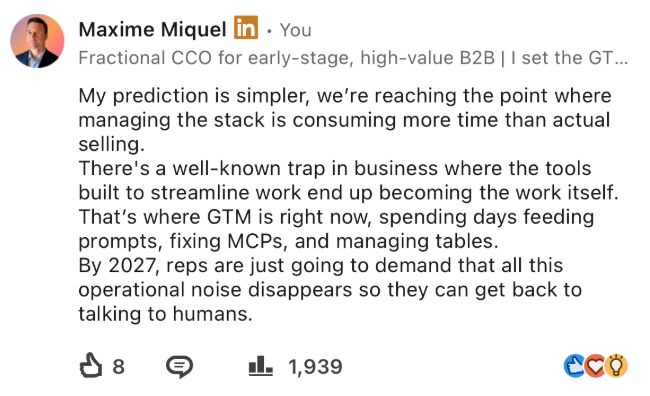
Start with the arithmetic, because it is the whole case. A rep has a fixed number of selling hours in a week. For fifteen years I watched the share of those hours going to the tools grow, a few points at a time. Each tool took a sliver. Nobody measured the sum. At some point the sliver became the slice, and the slice became the meal. When the hours spent operating the stack exceed the hours spent with buyers, the function has inverted, and most teams have not noticed because it happened one tool at a time.
Why it compounded in silence. Every tool in a modern GTM stack was bought against a specific pain, and each one made a defensible case on its own. Enrichment fixed a data gap. The sequencer fixed a follow-up gap. The CRM fixed a visibility gap. What none of them priced in was the cost of keeping the others in formation: the integrations that break, the fields that drift, the duplicated records, the dashboard that needs a dashboard. That cost never appears on a single invoice, so it never gets cut. It is an orchestration tax, and it is paid in the currency that matters most, a rep's time.
A rep who spends the morning fixing the thing that was supposed to save the morning has been given a second job, not a shortcut.
The AI wave made this worse before it will make it better. The promise was that agents would absorb the operational noise. The reality, for now, is a new layer to feed and police. Prompts to tune. Context to load. Integrations that fail overnight. Outputs to check before you trust them in front of a client. The work did not disappear. It moved upstream, closer to the rep, and it put on the costume of leverage.
Why the best reps revolt first. Top sellers are the most protective of their customer time, because that is where their number comes from. They feel the inversion earliest, and they have the leverage to refuse it. When a top performer walks out of a stack-heavy shop for a leaner one, leadership pays attention in a way no dashboard achieves. A backlash in sales does not start from the average rep. It starts from the ones a company cannot afford to lose.
Why 2027 and not next quarter. Adoption cycles have a shape. 2024 and 2025 were the pile-on: every team added an AI layer because not adding one felt like falling behind. 2026 is the hangover: the cost shows up in pipeline quality, in ramp time, in attrition, and it becomes hard to argue with. 2027 is the correction: teams cut the stack back to what moves a deal, buy the tools that give time back, and kill the ones that take it. That is a dated prediction, and I am prepared to be wrong on the year. I am not prepared to be wrong on the direction.
What survives the correction is simple to test. Ask of every tool: does this put me in front of a human sooner, or later? The ones that answer sooner stay. The rest are overhead with a login.
The stack was built to protect selling time. Somewhere it started eating it, and the full dashboards let everyone call that progress. The correction is coming either way. The only question left for a founder is whether you cut the noise yourself, or your best rep cuts it for you by leaving.
The story version of this argument, the morning it all starts from, is in The tools became the work.